
Knight v Bishop Endings
Sometimes the knight will be stronger than the bishop in these endgames, and sometimes the bishop stronger than the knight. As often happens in chess it will depend on the position of the pawns, the weaknesses each side can target, and of course the actual position on the board at every stage.
A knight is usually better when:
- The knight can find a suitable outpost and a way in to the opponents position with attackable weaknesses
- The opposing bishops mobility is limited by fixed pawns or pawn structures on the same colour as the bishop – Often you will want to fix your opponents pawns so that they get in the way of the bishop
A bishop is better when:
- The bishop is a good bishop – ie it moves on opposite coloured squares to your fixed pawns
- There are pawns and attackable weaknesses on both sides of the board when the bishops increased mobility can come into its own.
Thematic Tournament 1 – Good knight v bad bishop (Karpov v Kasparov 1984 – Game 9 starting from Karpov’s move 45). Game 9 of the first Karpov v Kasparov World Champs match is a classic example of how to play with a good knight against a bad bishop.
The game was played in October in the early stages of what became a marathon World Championship match continuing for 5 months and 48 game with the score at 5-3 and 40 draws. After 48 games FIDE president Campomanes decided the match was going on for too long and stopped the match amidst some controversy over concerns for the health of the players.
Game 9 of the marathon started with a Tarrasch defense to Karpovs queens gambit. We join the game after black’s 44th move Bxf5.
(7672) Anatoly Karpov – Garry Kasparov [D34]
Karpov – Kasparov World Championship Ma Moscow URS (9), 05.10.1984
1.d4 d5 2.c4 e6 3.Nf3 c5 4.cxd5 exd5 5.g3 Nf6 6.Bg2 Be7 7.0–0 0–0 8.Nc3 Nc6 9.Bg5 cxd4 10.Nxd4 h6 11.Be3 Re8 12.Qb3 Na5 13.Qc2 Bg4 14.Nf5 Rc8 15.Bd4 Bc5 16.Bxc5 Rxc5 17.Ne3 Be6 18.Rad1 Qc8 19.Qa4 Rd8 20.Rd3 a6 21.Rfd1 Nc4 22.Nxc4 Rxc4 23.Qa5 Rc5 24.Qb6 Rd7 25.Rd4 Qc7 26.Qxc7 Rdxc7 27.h3 h5 28.a3 g6 29.e3 Kg7 30.Kh2 Rc4 31.Bf3 b5 32.Kg2 R7c5 33.Rxc4 Rxc4 34.Rd4 Kf8 35.Be2 Rxd4 36.exd4 Ke7 37.Na2 Bc8 38.Nb4 Kd6 39.f3 Ng8 40.h4 Nh6 41.Kf2 Nf5 42.Nc2 f6 43.Bd3 g5 44.Bxf5 Bxf5

45.Ne3 Bb1 46.b4 Played by Karpov to fix the queenside pawns on light squares.
46…gxh4
47.Ng2!! Karpov thought for some time in this position before playing Ng2 with a very clever pawn sacrifice. The idea is for white to give the pawn up temporarily to keep an entry point for the knight and king into the black position.
47…hxg3+ 48.Kxg3 Now we reach a good knight v bad bishop position with K and N both able to infiltrate.
48…Ke6
And white will infiltrate with three black weakness to target and only one for white.

49.Nf4+ Kf5 50.Nxh5 Ke6 51.Nf4+ Kd6 52.Kg4 Bc2 53.Kh5 Bd1 54.Kg6 Ke7 55.Nxd5+ Abandoning the pawn
55…Ke6 56.Nc7+ Kd7 57.Nxa6 Bxf3 58.Kxf6 – W is now two pawns up.
58…Kd6 59.Kf5 Kd5 60.Kf4 Bh1 61.Ke3 Saving the pawn
61…Kc4 62.Nc5 Bc6 63.Nd3 Bg2 64.Ne5+ Kc3 64…Kb3 65.Kd3 Kxa3 66.Kc3 Winning as the W can start pushing the pawn with support from the N.
65.Ng6 Kc4 66.Ne7 Bb7 67.Nf5 Bg2 68.Nd6+ Kb3 69.Nxb5 Ka4
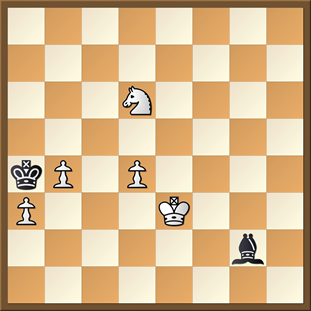
70.Nd6 Black resigned at this point as white will promote one of the passed pawns.
1–0
Thematic Tournament 2 – Good bishop vs bad knight
Moving forwards 27 years from the Karpov-Korchnoi game we have a second example of how to handle bishop v knight endings. This was played at the 2021 British Championships in Hull where GM Keith Arkell took on Oliver Stubbs. In the interests of fairness this game is an example of where the bishop dominates using its ability to move the length of the board and target multiple weaknesses.
As Howard Staunton once said – ‘The Bishop moves diagonally forwards or backwards, to the extent of the Board.’
The commentary has been extracted from the November 2021 edition of ChessMoves with annotations by GM Keith Arkell.
Keith Arkell – Oliver Stubbs
Over-the-Board British Championship Hull (7), 08.10.2021
1.c4 Nf6 2.Nc3 g6 3.g3 d5 4.cxd5 Nxd5 5.Bg2 Nb6 6.d3 Bg7 7.Be3 Nc6 8.Qd2 Nd4 9.Rc1 c6 10.Bh6 Bxh6 11.Qxh6 Nf5 12.Qd2 0–0 13.Nf3 Re8 14.h4 h5 15.Ne4 Nd6 16.Nc5 e5 17.0–0 Bf5 18.Ng5 Qe7 19.b4 f6 20.Nge4 Bxe4 21.dxe4 Rad8 22.Qh6 Qg7 23.Qe3 Kh7 24.Rfd1 Qf7 25.a4 Nbc4 26.Qb3 b6 27.Nd3 a6 28.Rc3 Re7 29.Rdc1 b5 30.a5 Nb7 31.Bh3 Rc7 32.Nb2 Nbd6 33.Rd3 Nxb2 34.Qxb2 Nc4 35.Qc3 Qe7 36.Rcd1 Rd6 37.Rxd6 Nxd6 38.Qc5 Nxe4 39.Qxe7+ Rxe7 40.Rc1 Rc7 41.Bg2 Nd6 42.Rxc6 Rxc6 43.Bxc6 Kg7

Following some very good chess from my opponent this was the best I was able to achieve after 43 moves – an endgame which offers some winning chances. My advantages consist in the Knight’s being tied to the defence of a6 and the possibility of my King breaking into Black’s position. It is obviously a big plus that Oliver’s a6, b5, g6 and h5 pawns are on the same colour as the Bishop.
44.f4 If I can persuade the e5 pawn to move, my King will have a direct route into Black’s queenside through the g1 – a7 diagonal.
44…Kf7 45.Bd5+ Ke7 46.Kg2 Kd7 47.Kf3 Ke7 47…Kc7 won’t free the Knight to move as there will then be nothing defending the g6 pawn, so Black must wait in the centre with his King.
48.e3 Kf8
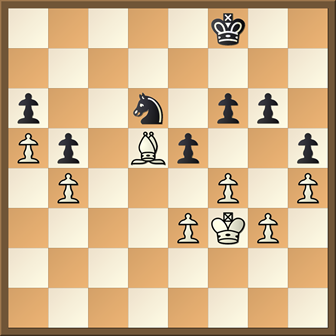
49.e4 For me move 49 is rather early to play e4, but it is necessary to make any progress. My idea is to play g4 followed by g5 in order to prize open the Black squares for my King’s entry. The problem is that against the immediate 49 g4 Black can randomise the position with 49…e4+ 50 Kg3 hxg4 51 Kxg4 Nf5!
49…Kg7 50.g4 hxg4+ I was hoping for 50…Kf8 51 g5 Ke7 52 gxf6+ Kxf6 53 fxe5+ Kxe5 54 Ke3 when Black with have to give way decisively due to Zugzwang, a theme which will soon gain in importance.
51.Kxg4 Kh6

52.Ba8 I want to be able to play Kg5 after I take on e5, and this triangulation with the Bishop places my opponent in Zugzwang.
52…Kg7 53.Bc6 Kh6 54.Bd5 Kh7 Against 54…Kg7 I intended 55 fxe5 fxe5 56 Kg5 with another Zugzwang because 56…Nf7+ 57 Bxf7 Kxf7 58 h5 is a won K+P ending.
55.fxe5 fxe5 56.Kg5 Kg7 57.h5 gxh5 58.Kxh5 Kh7 [58..Kf6 also allows me to penetrate his position with 59 Kh6.
59.Kg5 Kg7 60.Ba8 Again we see the triangulation theme to bring about yet another Zugzwang!
60…Kf7 61.Bc6 Ke6 After 61…Ke7 62 Bd5 my King will gain access to f6 when the e pawn will soon fall.
62.Kg6 Ke7 63.Bd5

The 4th Zugzwang of this endgame.
63…Ne8 64.Bb7 Nc7 An amusing idea which I was aware of during the game was that if Oliver tries to trap my Bishop with 64…Nd6 my a-pawn queens, viz: 65 Bxa6 Kd7 66 Bb7! Nxb7 67 a6.
65.Kf5 Kd6 66.Bc8

And after Zugzwang number 5 the Black pawns will start to drop off.
66…Ne8 67.Bxa6 Ng7+ 68.Kg6 Ne6 69.Bxb5 Nd4 70.Ba4 Ne6 71.Bb3 Nf4+ 72.Kf6 Nd3 73.b5 Kc5 74.b6 Nb4 75.b7 Na6 76.Kxe5 Kb4 77.Bd5 Kxa5 78.Kd6 Kb6 79.e5

1–0
Tournament results – Bishop v Knight – Who wins?
You can find the two thematic tournaments at the links here. These were played in Arena format at 3|2 on Saturday 15th January. GM Keith Arkell joined us for both tournaments and was able to give some expert advice in the chat.
In general the side with the stronger minor piece won or drew but there were a few upsets as the positions can get quite double edge.
As ever, some careful play is required to convert this sort of advantage with calculation required at the right points as the position develops.